21 Sep 2026
Australia’s moving industry is overdue for a technology revolution
How will the largest technology revolution of all time impact removalists?
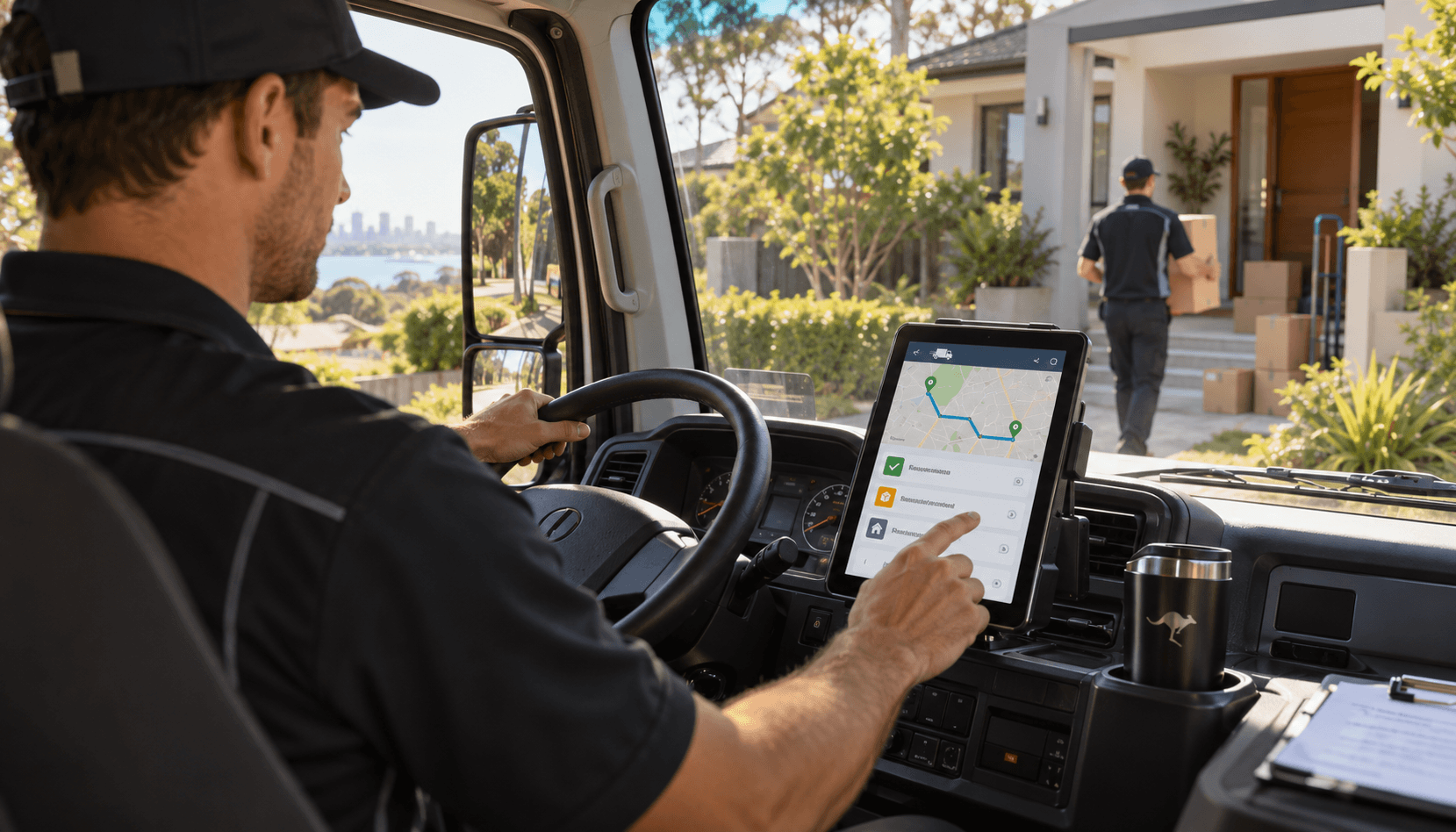
A growing removalist business can buy another truck. What it cannot buy quite so easily is another version of the owner: someone who remembers every customer promise, knows which crew to send, understands the pricing exceptions and can reorganise tomorrow’s schedule when something changes.
That gap between having more capacity and being able to manage it is where I believe the next chapter of Australia’s moving industry will be decided, and its fundamentally a problem of scale.
In my experience, removals has remained relatively static in its adoption of business technology. There are innovative operators and capable systems, but too much of the work still depends on manual coordination, disconnected tools and knowledge held in a handful of people’s heads.
This is not because removalists lack ambition. It is because moving is a much harder industry to build good software for than it first appears.
Now, artificial intelligence is creating an opportunity to change that equation. But making the most of it will require more than adding a chatbot to a website.
Why removals has been difficult to serve with software
Freight operators have an established category of transport management systems, or TMS, designed to support transport planning, shipment tracking, carrier coordination and freight billing. These systems address the movement of goods as a connected operational process.
Removals has specialist software too. The challenge is that moving a household requires much more than managing a consignment.
IBISWorld’s description of Australia’s removalists industry captures some of that breadth: it encompasses relocation services for households, businesses and government clients, across local, long-distance and international moves, with packing and storage also forming part of the offering.
A removals business sits at the intersection of logistics and customer service. In many ways, it is a home-services business with a demanding logistics operation behind it.
The customer is not simply buying transport. They are trusting someone to enter their home, handle their possessions and deliver on promises during a significant life event.
The business needs to understand what is moving, explain the price, organise access, coordinate dates and manage expectations. Behind the scenes, it must allocate trucks and crews, plan transport, track inventory, handle storage, collect payments and deal with insurance-related administration and claims.
A traditional customer relationship management system might handle the sales conversation but struggle with the operational detail. A transport system might handle the logistics but miss the customer journey.
An effective all-in-one platform has to connect both.
Earlier transport revolutions, particularly containerisation, changed the economics and mechanics of moving goods between ships, trains and trucks. The next opportunity for removals is different: changing how the entire business operates around that physical movement.
The software has to be broad and flexible
The breadth of removals is only half the problem. The other half is variation.
In the businesses we work with, one operator might quote local moves by the hour, while another specialises in fixed-price interstate relocations. Some operate their own fleets. Others rely heavily on contractors. Storage might be an occasional add-on or a substantial business in its own right.
Even businesses offering similar services can have different ways of collecting deposits, approving quotes, assigning work and communicating with customers.
From a software business’s perspective, that creates a challenging proposition: a specialised market that needs an unusually extensive product, with enough flexibility to accommodate different operating models.
In my experience, this helps explain why solutions have so often emerged from inside the industry. An operator encounters a problem, builds something to solve it and eventually turns that system into a product.
That industry knowledge is valuable. The difficulty comes when the software’s original assumptions become difficult to change.
Every product makes choices about how work should happen. A system built around one company’s processes can work brilliantly for businesses that operate the same way, but become restrictive for those that do not.
The answer is not unlimited customisation. Nor should software preserve every inefficient habit simply because it is familiar.
The goal should be a reliable common foundation, with flexibility where businesses genuinely need it: pricing, service combinations, workflows, permissions, communication and resource allocation.
Thin margins make technology an operating necessity
For the operators I speak with, margins can be razor thin. A business can be busy, its trucks can be on the road every day, and the financial result can still be disappointing. Particularly against a backdrop of increasing customer acquisition costs, rising diesel costs, and scarce skilled labour.
Buying more capacity does not automatically fix that.
Another truck creates another opportunity to earn revenue, but also another asset that needs to be funded, maintained and kept productive. A larger warehouse only improves the business if its space is used effectively and the associated services are properly administered and billed.
The real question is whether growth produces more profit or simply more coordination.
Consider a simple illustration:. A business generating $2 million in annual revenue at a 10% operating margin makes $200,000 in operating profit. Recovering $40,000 a year through fewer errors, better utilisation and less administration, after the cost of the technology, would increase that profit by 20%, without increasing revenue.
That is why relatively small operational improvements deserve serious attention.
A missed charge, an unproductive return trip, a preventable scheduling mistake or hours spent re-entering information might seem manageable in isolation. Repeated across a growing business, they become a constraint.
The purpose of technology is not just to help a removalist manage more trucks. It is to help the business earn a better return from the trucks, people and facilities it already has.
Build versus buy: the expensive part is not just writing the code
When existing software does not fit, building your own system is an understandable temptation.
You know the industry. You know your processes. You can picture exactly how the system should work.
Surely it is just a matter of explaining it to a developer?
Recently, I spoke with a company that moved to Movepro after abandoning its own software project. They told me they had spent around $150,000 with developers before deciding to bin the whole thing.
While that is just one company’s experience, it illustrates a problem I think is routinely underestimated.
Knowing how your business works is not the same as being able to specify how software must work.
Much of an experienced operator’s knowledge is tacit. It comes from years of recognising exceptions, making judgement calls and understanding what customers or staff actually mean.
Turning that into software requires someone to extract the knowledge, document it, resolve ambiguities, communicate it to developers and then validate that the finished system behaves correctly.
Take a seemingly simple instruction: “Let staff reschedule a job.”
Does the packing service move too? What happens to the crew allocation? Does the price change? Should the customer receive a notification immediately, or only after approval? What happens if another staff member is editing the same booking? What if the crew has already downloaded the original instructions?
The developer cannot reliably infer all of that from a sentence.
The gap between what is obvious in an operator’s head and what is explicit in the development brief is where a supposedly straightforward project becomes expensive.
The removals industry is full of what I refer to as "edge cases". Sure, you can "vibe code" a system that does what appears to be 80% of the functionalty you need. But the devil is in the detail. That "remaining 20%" is actually 100x more work, and is fundamentally required for a system to actually be reliable.
I experienced this myself between 2021 and 2023 when we rebuilt he system that ran Muval. The first version of the Muval software I built myself over time - gradually adding bits and pieces as we needed it. Now, I'm an average software engineer at BEST, and so by mid 2021 the whole system was really just held together with proverbial sticky tape and required a thorough rebuild. I knew it wasn't a small task, but we already had a working version of what we needed, we just needed it to be rebuilt in a more robust way.
The next 2 years were hell, mainly due to all of the small tacit assumptions embedded in my code that were never made explicit to the new development team. We were still 18 months in to the rebuild and fundamental things were being flagged as things that the development team had no idea about. It was insanely stressful and incredibly costly to our business.
...and all of that was working off a base of an exisitng software system that already did what we needed it to. Imagine the difficulty starting from scratch with just whats in your head.
The first version is only the beginning
Even a successful initial build creates an ongoing responsibility.
As the business grows, it needs to consider new branches, more users, different permissions, integrations, reporting, data recovery and increasingly complex exceptions. Security is not a one-off task either: established software-development guidance treats it as part of the development lifecycle, including addressing vulnerabilities and preventing their recurrence.
The ceiling is not necessarily a particular number of trucks or bookings. It is the point at which the system’s demands exceed the time, expertise and funding the business is prepared to commit.
The owner’s attention becomes divided between running a removals company and overseeing a software operation. Operational improvements compete with bug fixes. New services wait for development work. The system intended to enable growth can become something the business has to work around.
There are good reasons to build proprietary technology, particularly when it creates a genuine competitive advantage and the business can support a permanent technical capability.
But “we could build this” is a different proposition from “we should own and maintain this indefinitely”.
Buying software is not effortless, either. It still requires process decisions, migration, training and clear internal ownership. The difference is which responsibilities the removals business chooses to retain and which it can share with a dedicated software provider.
AI makes building more tempting. It does not remove the hard part.
Even when AI makes a prototype dramatically faster to produce, the fundamental questions remain.
What should the system do? What should it never do? Which decisions require approval? How will you know the result is correct?
A polished demonstration is not proof that the software can safely run a business.
AI may help turn instructions into code, but the business still needs to identify missing requirements, test unusual situations and decide whether the implementation reflects the intended process.
The same ambiguity that causes problems in a development brief can be reproduced in an AI prompt, only faster.
For many operators, I believe the better approach is to buy a dependable core platform and customise around it where there is a genuine commercial reason.
An open, extensible platform offers a more useful middle ground than choosing between inflexible software and rebuilding an entire business-management system from scratch.
You should be able to differentiate how your business serves customers without becoming responsible for every underlying component.
The next revolution will connect the whole customer journey
I believe artificial intelligence could become the most significant technological shift of our working lives, potentially much more. The Productivity Commission has identified its transformative potential for productivity, while also highlighting the importance of data and managing the associated risks.
For removals, the most exciting opportunity is not AI operating as a separate novelty. It is AI working across the business.
Imagine a customer making an enquiry in their own words. The system helps organise that information, identifies missing details and prepares a useful starting point for a quote.
Once the scope is understood, scheduling tools consider the actual resources available: truck capacity, crew availability, travel, access restrictions and other commitments.
The office reviews the plan. The crew receives the relevant instructions. Changes made during the job flow back into the operational record, rather than waiting to be reconstructed from phone calls and paperwork.
Completion then initiates the next appropriate steps: updating the customer, reconciling work performed, preparing billing and assigning any follow-up tasks.
That is the direction I see the industry heading. Not just faster individual tasks, but fewer gaps between them.
However, automation needs boundaries. NIST’s AI Risk Management Framework emphasises incorporating trustworthiness into the design, use and evaluation of AI systems. For a removals platform, I believe that translates into clear permissions, review points, records of actions and sensible escalation when something is uncertain.
AI should not confidently promise a truck the business does not have, change a customer’s price without authorisation or conceal uncertainty behind a reassuring message.
The goal is to automate avoidable administration while giving people better information and more time for the work that requires judgement.
What we are building towards at Movepro
At Movepro, our starting point is the practical reality of running a moving company. The platform brings together sales, scheduling, customer communication, field tools and administration, including digital inventory and condition reporting.
Our development priorities are not simply a list of technologies to adopt. They are business outcomes we want to help operators achieve, through the core platform today and the capabilities we are building next.
Convert more of the enquiries you already receive
A better sales experience should make it easier for customers to understand the offer and move forward.
That means timely responses, clear pricing, useful follow-up and a straightforward path from enquiry to acceptance and payment. The objective is to help operators win more suitable work without relying solely on buying more leads.
Increase customer value through genuinely useful services
Packing, unpacking, storage and other relevant services should be easy to present as part of a coherent moving experience.
Our broader direction also includes making ancillary offerings, such as connection services and appropriate protection products, easier for operators to offer.
The opportunity is not to overwhelm customers with extras. It is to understand what they need, present it clearly and make the removalist a more useful part of their move.
Reduce avoidable claims and disputes
We want to help operators communicate thoroughly before, during and after a move: confirming scope, recording access requirements, documenting condition and making responsibilities clear.
Better records do not replace careful handling, and software cannot eliminate claims. But the aim should be to prevent avoidable misunderstandings and make it easier to establish what happened when a problem arises.
Keep the office and field working from the same information
A schedule should not exist in several conflicting versions across a whiteboard, a spreadsheet and a collection of text messages.
Movepro’s scheduling and field tools are designed to connect resource assignments, job tasks and crew updates, with offline working available in the field app when connectivity is unavailable.
The objective is to reduce scheduling errors, missed instructions and the constant need for someone to manually relay information between teams.
Automate workflows across the business
Our AI direction is about connecting work across sales, operations, field teams and administration.
A change in one area should initiate the appropriate action elsewhere, with clear rules about what happens automatically and what needs review.
Success should be measured in practical terms: less duplicated work, fewer missed handovers, faster completion of administrative tasks and more time for staff to focus on customers and exceptions.
Better technology should make moving more human
The future of removals should not be a choice between personal service and efficient operations.
The right technology should strengthen both.
It should give the salesperson time to understand the customer. It should give the operations manager confidence in the plan. It should give the crew clear instructions and a straightforward way to record what happens. And it should give the owner a business that does not depend on their personal intervention in every decision.
My view is that the strongest moving companies in the years ahead will not necessarily be those with the largest fleets. They will be those that combine their industry knowledge with the systems to deliver consistently, use their assets productively and make customers feel looked after.
That is the opportunity we are building Movepro around.